Friday, 2 February 2018

Climate change: in it for the long haul

Credit: pixabay

How does the climate vary naturally over millennial time scales?
Can contemporary climate change be explained by natural variations?
What is the evidence for climate change? 


1) Put simply, the climate gets warmer and cooler again, in its natural and delicate balancing act. The most obvious example of a climate feedback is the ice albedo feedback: larger ice cover reflects more radiation back to space, keeping it cooler. As ice cover decreases, more radiation is absorbed by the darker coloured water, and the temperature rises. Part of the reason for the Earth's changing climate over millennia are slight changes in the Earth's orbit around the sun.

2) The evidence for contemporary climate change exceeds the temperature ranges previously seen in natural variations, suggesting there must be another factor at play to explain the extremes we are seeing now. Data also suggest that the climate is changing at a much greater speed than previously seen in natural variations. The US Forest Service explains it succinctly:
"Climate varies without human influence, and this natural variation is a backdrop for the human-caused climate change occurring now" 
3) Some climate deniers would have you believe that the evidence for climate change is largely disputed, anecdotal and insubstantial. It isn't:
  • rising sea levels
  • decreasing ice cover
  • rising levels of CO2 and other GHGs
  • rising global average temperatures on land and sea

Sources: The Royal Society; Nasa; Inside Climate News

Thursday, 1 February 2018

The past is a foreign country: they do climate differently there


Credit: pixabay  

What can we learn from the past? Is it important to know about the climate on timescales that are almost incomprehensible to our human lifespans?


Timescales give ammunition to climate deniers as they can say, 'we survived before and we'll survive again' (glossing over the fact that 'we' was very different then, and didn't include humans).

The fact that we know how extreme the PETM was, and there is still no global urgency to combat a warming planet, suggests the fear factor isn't working. I think most people in the developed world are aware of climate change but also know they will be protected from the worst effects of it by time (they'll be dead), location or money.

There have been a few comments (on the discussions boards of the University of Exeter's Climate Change: The Science course) damning politicians for a lack of action. I've nothing against damning politicians, but - while you can cite eco 'gestures' for most countries in the world - no country is leading on climate change - the inertia is terrifyingly widespread. This is no doubt partly because, again, of the timescales involved - election in four years' time vs data from 56 million years ago - but also because there is not one set of actions agreed upon that would halt climate change.

Somebody mentioned they felt switching their TV off standby was worthless in the face of massive industrial and leisure projects that guzzle energy and belch carbon. I think some politicians and countries also feel like that (it's certainly a theme that has emerged at previous climate talks) - why should I risk my political career/country's economy/unemployment stats if my neighbour consumes coal like it's jelly babies?

And green issues are so broad that it's difficult to ascertain what is specifically an action to limit - I don't think we can say prevent any more - global warming, and what is a more generalised environmentally friendly way of living. And people are full of contradictions - using a reusable coffee cup and flying lots; religiously recycling all their meat trays; driving to the organic supermarket in a diesel car.

One thing that hasn't been mentioned yet much in the threads is population. Part of the horrors of plastic are not simply because of plastic per se, but because of the sheer volumes of it that 7 billion people use. Same with greenhouse gases.

Technology is a way forward, perhaps the only way. People don't invent (or mass produce) a climate-saving device, such as compostable packaging, carbon capture and storage, solar panels, a TV that turns off automatically, until the demand is there. And when it comes to selling stuff, the world listens more to consumers than politicians.

Wednesday, 31 January 2018

It's getting hot in here, so take off all your clothes (in an attempt to reverse the Paleocene-Eocene Thermal Maximum)

Credit: pixabay
Alarm bells are not subtle things. Think car alarms going off outside your window in the middle of the night, or the neighbours' burglar alarm going off the day after they've gone on holiday for a fortnight. Alarms are there for a reason. They are intended to make us stop what we're doing and take action.

Planet Earth is warming. Regardless of the whys, and the variety of means to combat temperature rises, if it ends up becoming uncomfortably hot then we can't say we weren't warned. It's happened before.

Step in the Paleocene-Eocene Thermal Maximum. This refers to when it got really hot earlier in the Earth's life (I would give you the exact number of million years, but I find numbers bigger than 100 tend to turn people off. We just can't conceptualise time over such a great span).

Anyway, when the PETM happened, you could have caught Santa sunbathing in the north pole. Some of the impacts are similar to things happening now: the oceans becoming more acidic and sea levels rising.

It also caused some species of organisms - that's precursors to cute animals - to become extinct and ecosystems to migrate. Climate refugees, if you like.

Yes, the planet recovered after the PETM. But this time it's happening much more quickly. According to the University of Exeter (which is running the fascinating Climate Change: The Science course that I'm taking part in):
"The PETM had warming of around 0.025˚C per 100 years. Currently, we’re on track for around 1˚C of warming per 100 years" 
As part of the course, we're asked:
  • Do you think the PETM has some similarities with today’s climate change? 
  • What lessons can we learn from this event to ensure the impacts don’t happen again? 
Undoubtedly there are similarities; a large dumping of CO2 occurred, and it warmed the planet significantly and, by geological standards, quickly. What's more alarming is the difference: the PETM occurred much more slowly than the current anthropogenic climate change we're experiencing. And although some of the outcomes are undoubtedly similar, the Earth is a very different place to the one that experienced the PETM. For a start, there are 7 billion humans on it. 

I'm not sure of the lessons learned yet. There seems to be a lot of carbon stored in the ground, so I'm thinking drilling is probably going to be a bad idea. The PETM showed that the Earth heats up a lot more quickly than it can cool itself down again. Has anyone measured the comparative speeds of positive warming and cooling feedbacks? And also, what's the role of trees? Is the albedo effect solely to do with the reflective properties of ice and snow, or are they also cooling because they don't support vegetation? And are trees as important a carbon sink as carbon stored in rocks and volcanoes?

Tuesday, 30 January 2018

I'll be 490 by the time …

… all the nappies I've used (on my children) have decomposed. That's shocking, and sad.

Image from https://earthrespect.wordpress.com/

Thursday, 25 January 2018

Climate feedbacks ... remind me what they are again?

Credit: pixabay
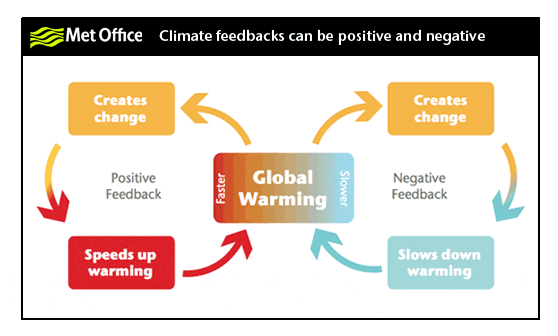
Still, as a non-scientist, trying to get my head around climate feedbacks and found a couple of useful things: a graphic, a definition and a list of climate feedbacks (most of which is a bit detailed for me but still interesting).

Credit: www.powerplantccs.com/Met Office
Here's the definition, also courtesy of the above website:

"An interaction between various processes of climate system is called climate feedback, where in the result of one process triggers changes in the another process that in turn will influence the initial one. There are many climate feedback mechanisms that can either amplify or diminish the effects of climate change contributing factors. A positive feedback is one that can amplify the effects of climate change while negative feedback is one that diminishes the same."

And a list of the climate feedbacks, positive (but not good!) and negative.

The above link contains an interesting paragraph on clouds, which I hadn't really thought about other than often finding them pretty or portentous:

"Clouds are the elephant in the living room. They're obviously extremely important, but they are very poorly understood. High, wispy cirrus clouds have a warming effect, because they are made of ice crystals, which makes them much more nearly opaque to outgoing longwave infrared than to incoming visible and near-IR solar radiation. Lower clouds, which are made of liquid water droplets, have a strong cooling effect in daytime, but a warming effect at night. How clouds are affected by warming or cooling climate is very complex."

Wednesday, 24 January 2018

Nitrous oxide, the funniest of the greenhouse gases ...

Credit: pixabay
I'm taking part in Future Learn and the University of Exeter's course on Climate change: the science. This is my first bit of research, on N2O. Bear with me, it's week one and it's a long time since I did GSCE chemistry.

My research questions are:
  • Which human activities lead to the emission of your chosen greenhouse gas? 
  • What is the impact of your chosen greenhouse gas on the blanket effect? 
  • How will your chosen greenhouse gas impact important climate feedbacks? 
I chose N2O, cos CO2 is a bit passé.

The main human activities that contribute to N2O emissions are farming and the massive increase in the addition of nitrogen fertilisers to the soil over the past 100 years in order to produce more food to feed a growing global population. Microbes link the nitrogen in the soil with oxygen in the air to form N2O.

In a similar way, changes in land use also release N2O, particularly converting forest land to pasture for grazing animals.

Other human activities that emit N2O include: burning fossil fuels and wood; sewage plants; nitric acid manufacturing.

N2O has an impact on the blanket effect as, although there is much less of it in the atmosphere than water vapour or CO2, it traps heat more effectively than other GHGs do. Also, it lasts in the atmosphere much longer than other GHGs, resulting in a much higher global warming potential.

There are four key ways in which N2O affects climate feedbacks:
  1. N2O depletes the ozone layer as it passes through the atmosphere, reducing the protection that the ozone layer gives against the warming effect of ultraviolet radiation from the sun. 
  2. Using nitrogen fertiliser results in N2O emissions, which increase global warming. A warmer planet means more CO2 in the atmosphere, and plants may require more nitrogen fertiliser if there is more CO2 in the air. 
  3. Global warming is thawing the permafrost in Arctic regions. This thawing releases more N2O as microbes in the soil link the nitrogen in the soil with the newly accessible oxygen in the atmosphere. 
  4. Loss of nitrogen from the soil through soil degradation and runoff makes it harder for plants to grow, and plants are important for containing global warming as they remover carbon dioxide from the atmosphere. 
Sources: BBC; Nasa; the Conversation; Global Change Biology journal; Earth Island Journal.